

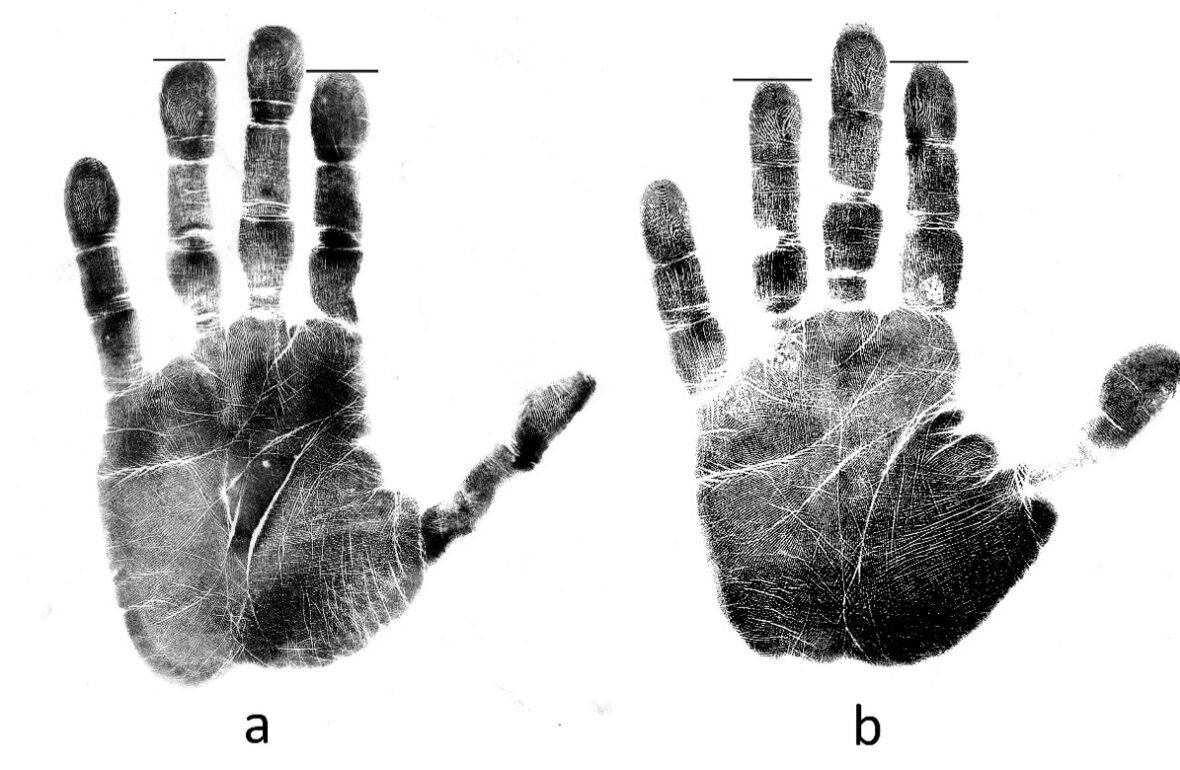
Most people glance at their hands without realising that the relative length of their index and ring fingers has been the subject of hundreds of peer-reviewed scientific studies — linking it to personality, behaviour, mental health, hormones and even financial success.
This article explores what the science says about finger length ratios, known in research as the 2D:4D digit ratio. It draws on my published systematic review of hand biomarkers and mental health (Rook, 2022) and the wider body of research in this field.
A note before we begin: in a hand analysis or chirology session, I would never reduce a person’s index or ring finger to a single population-level statistic. The science discussed here operates at a group level — identifying correlations across large samples. In therapeutic chirology, the index and ring fingers are explored individually and in full context — what they reveal about a person’s sense of self, their relationship to authority and identity, their introversion or extroversion, and how all of this interacts with every other feature of their hand. The science has identified that something real is happening with finger length ratios. Chirology explores what that means for the individual sitting in front of you. Both are valuable — they are simply operating at different levels of resolution.
What is the Digit Ratio?
The digit ratio — written as 2D:4D — is the ratio of the length of the index finger (2D, second digit) to the length of the ring finger (4D, fourth digit). It is calculated by dividing the length of the index finger by the length of the ring finger.
A ratio below 1.0 means the ring finger is longer than the index finger. A ratio above 1.0 means the index finger is longer. Most people fall somewhere around 0.95 to 1.0, but there is meaningful variation — and that variation, research suggests, is not random.
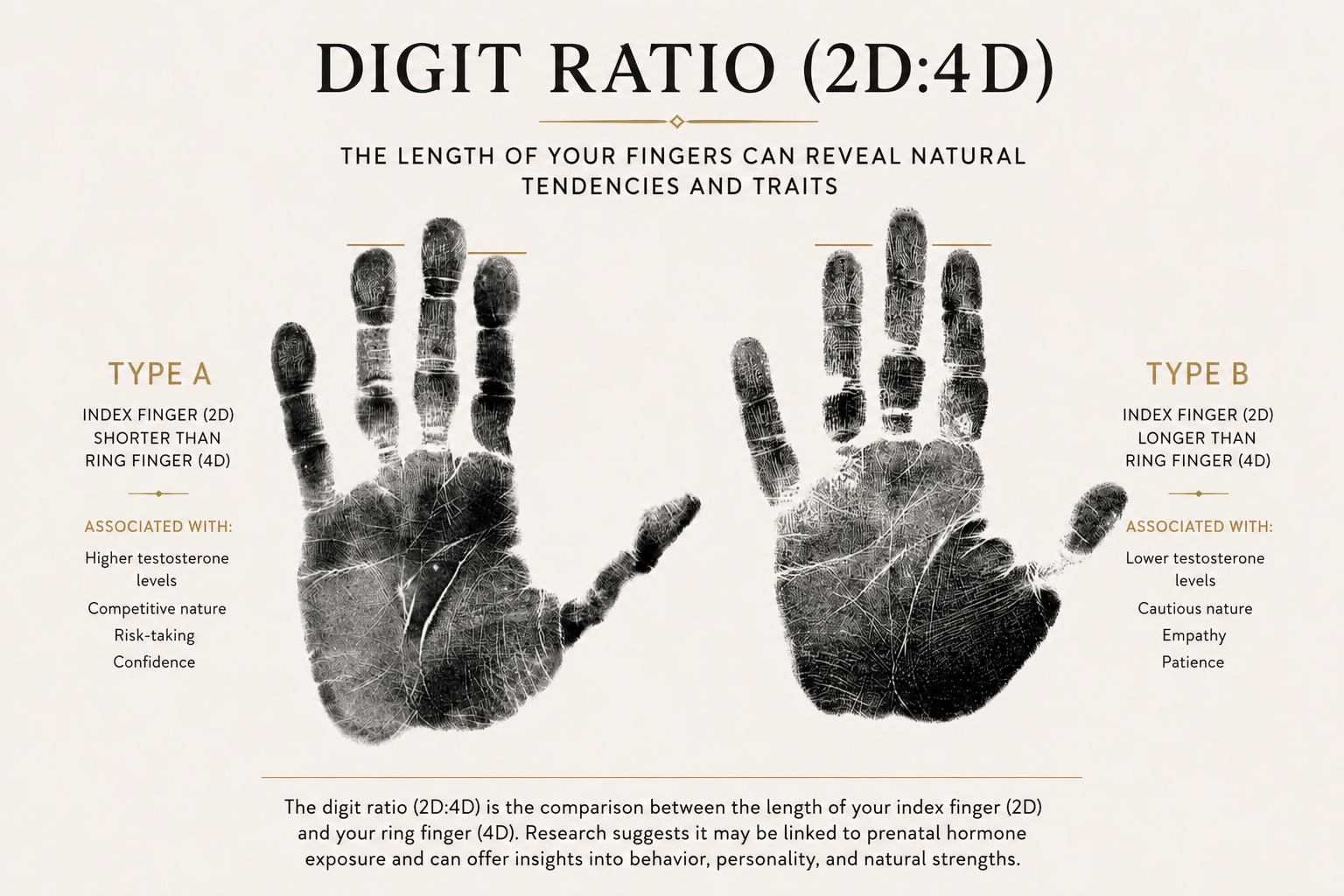
Type A (low ratio) and Type B (high ratio) — the two digit ratio patterns and their associated traits
How to Measure Your Digit Ratio
You can get a rough measure at home:
- Place your right hand flat on a piece of paper, palm facing up
- Measure the length of your index finger from the bottom crease of the finger to its tip
- Measure the length of your ring finger in the same way
- Divide the index finger measurement by the ring finger measurement
For example, if your index finger is 70mm and your ring finger is 74mm, your ratio is 70 divided by 74 = 0.946.
Most research uses the right hand, though some studies examine both hands and their asymmetry separately. For a precise measurement, a digital calliper gives more accurate results than a ruler.
What Does the Digit Ratio Reflect?
The digit ratio is considered a biomarker of prenatal hormonal exposure — specifically the balance between testosterone and oestrogen in the womb during early foetal development (Bull & Benson, 2006). The fingers form during the first trimester, and the relative lengths of the index and ring fingers appear to be influenced by the hormonal environment at that time.
A lower digit ratio — where the ring finger is notably longer than the index finger — is associated with higher prenatal testosterone exposure. A higher digit ratio — where the index finger is longer or equal — is associated with higher prenatal oestrogen exposure.

Long ring finger — lower digit ratio
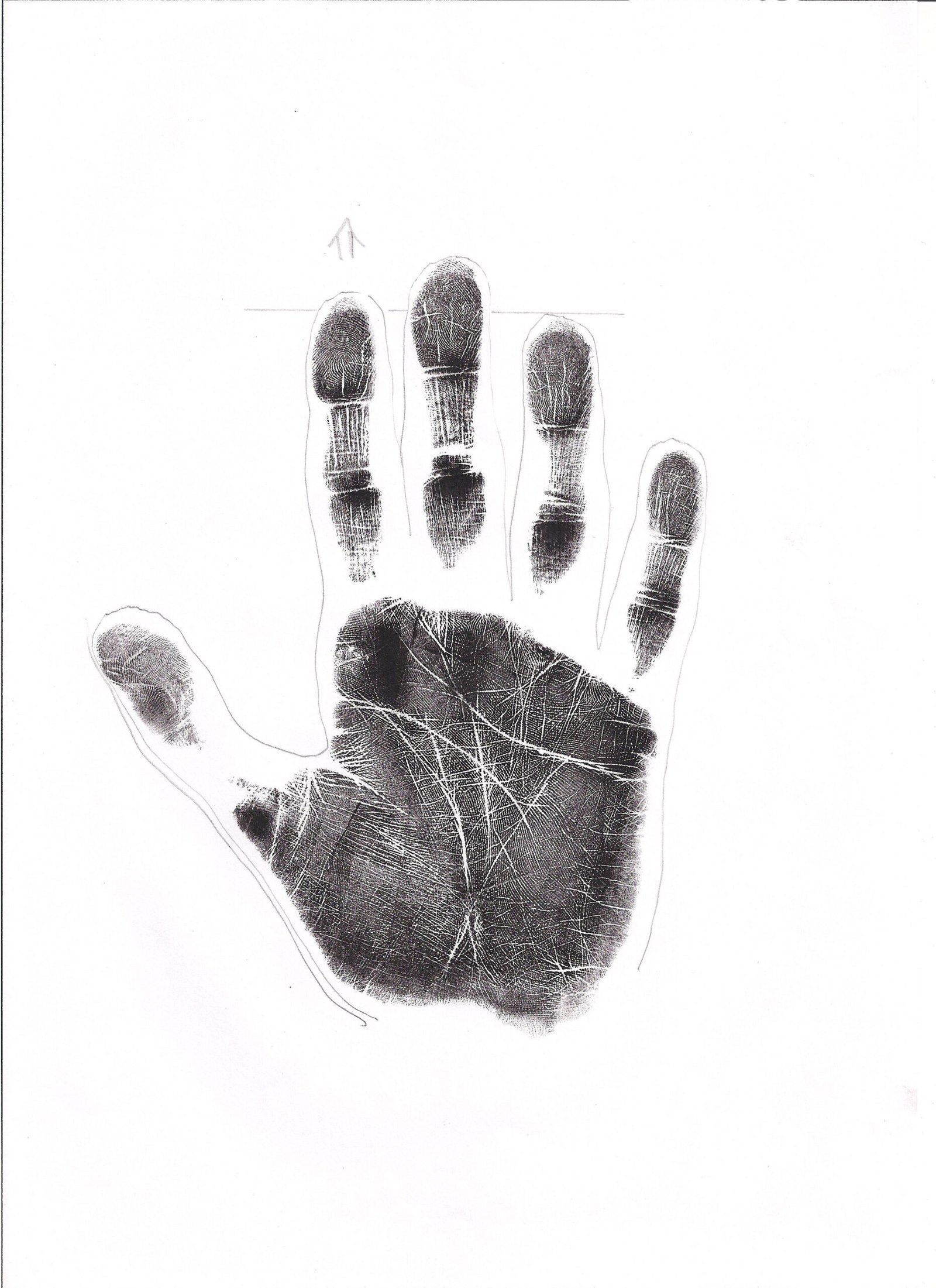
Long index finger — higher digit ratio
This is why the digit ratio shows a clear sexual dimorphism. On average, men have lower digit ratios than women — reflecting the higher prenatal testosterone environment typical of male foetal development. This difference is consistent across cultures and populations, making it one of the most reliably replicated findings in this field (Manning et al., 1998).
Because prenatal hormones influence brain development and a wide range of psychological and physiological traits, researchers have investigated whether the digit ratio can serve as a window into these deeper biological influences.
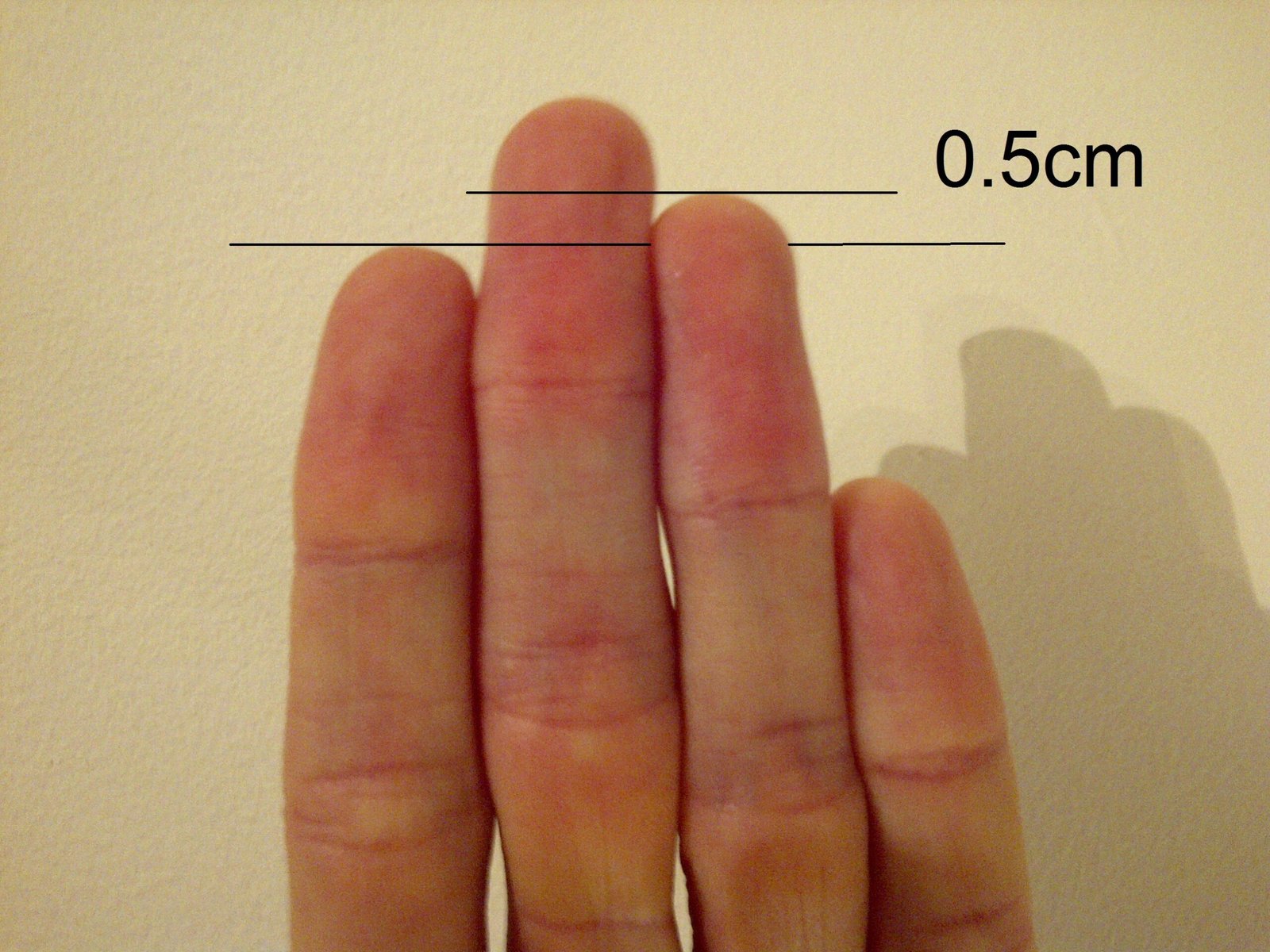
A hand showing a digit ratio in the normal range
Digit Ratio and Behaviour
Some of the most compelling — and most widely reported — digit ratio research concerns behaviour, personality and risk-taking.
Aggression
Lower digit ratios, associated with higher prenatal testosterone, have been linked to increased physical aggression in men. Bailey and Hurd (2005) found a significant association between lower digit ratios and physical aggression in male participants. Similar findings emerged from research on Italian professional footballers, where lower digit ratios correlated with aggression on the pitch (Perciavalle et al., 2013), a result supported by a subsequent meta-analysis (Turanovic et al., 2017).
Risk-Taking and Financial Trading
Perhaps the most striking digit ratio research comes from the world of finance. Coates and Herbert (2008) studied traders on a London trading floor and found that those with lower digit ratios — indicating higher prenatal testosterone — were significantly more profitable over a period of 20 months. A follow-up study by Coates, Gurnell and Rustichini (2009) confirmed that digit ratio predicted long-term success among high-frequency financial traders, with lower ratios associated with greater profitability and longer careers in trading.
More broadly, lower digit ratios have been associated with a preference for financial risk-taking (Branas-Garza et al., 2018) and a higher propensity for extreme risk activities such as skydiving (Massimino et al., 2019).
Personality
Research on digit ratio and broader personality traits has produced more mixed results. Lippa (2006) examined the relationship between digit ratios and the Big Five personality dimensions, finding only weak associations — suggesting that while digit ratio may influence specific behavioural tendencies, it does not robustly predict complex personality dimensions as a whole. This is consistent with what we would expect from any single biomarker.
Digit Ratio and Psychology
A substantial body of research has examined the digit ratio in relation to mental health conditions, with the underlying hypothesis that prenatal hormonal influences on brain development may be reflected both in finger length ratios and in the risk of certain psychological conditions.
Autism Spectrum Disorder
The digit ratio has been one of the most studied biomarkers in relation to autism spectrum disorder (ASD). Early research by Manning et al. (2001) found that children with ASD had significantly lower digit ratios compared to controls, consistent with the Extreme Male Brain theory — the hypothesis that ASD is associated with an unusually high prenatal testosterone environment (Baron-Cohen et al., 2011). A subsequent quantitative review by Honekopp (2012) confirmed that individuals with ASD showed an average digit ratio reduction of 0.5 to 0.6 standard deviations compared to controls.
ADHD
Research on ADHD and digit ratio has generally pointed toward lower ratios in affected individuals, consistent with hormonal influences on attention and impulse control, though findings have been less consistent than in ASD research (Martel, 2009; Stevenson et al., 2007). Some studies found no significant association, and results appear to vary depending on whether comorbid conditions are present.
Schizophrenia
The relationship between digit ratio and schizophrenia has shown higher ratios — associated with higher prenatal oestrogen — in affected individuals compared to controls. Qian et al. (2016) found significantly higher mean digit ratios in both male and female schizophrenic patients compared to controls in a Chinese sample. Collinson et al. (2010) found similar results among schizophrenic Asian males. Bolu et al. (2015) found significantly more asymmetrical digit ratios between left and right hands among schizophrenic patients, suggesting developmental instability as a potential mechanism. While not all studies are consistent, the overall picture suggests a meaningful association.
Eating Disorders
Eating disorders have been examined in relation to digit ratio, with research linking lower ratios to anorexia — suggesting prenatal testosterone as a contributing factor in its aetiology (Quinton, Smith and Joiner, 2011). However other research has produced differing conclusions, and the evidence here remains less settled than in ASD research.
Substance Use and Addiction
Lower digit ratios have been associated with alcohol dependence and addictive substance use in several studies (Lenz et al., 2019; Cicek et al., 2017; Kornhuber et al., 2013). Research suggests a pattern of lower, more masculinised digit ratios across various addictive and impulsive behaviours.
Depression
Results on depression and digit ratio are inconsistent. Some studies have found higher ratios associated with depression in men (Bailey and Hurd, 2005) while others found higher ratios associated with depression in women (Smedley et al., 2014). A large-scale study by Sanwald et al. (2019) found no significant association between digit ratio and depression severity, suggesting that digit ratio may not be a reliable biomarker for depression.
Honest Limitations
The digit ratio research is genuinely fascinating and the volume and consistency of findings in certain areas — particularly ASD, risk-taking and sexual dimorphism — suggest that something real is being measured. However several important limitations must be acknowledged.
The digit ratio is a single biomarker. As my own published systematic review of hand biomarkers established (Rook, 2022), single hand features are weak predictors of complex psychological conditions. The research consistently shows that combining multiple biomarkers produces far more meaningful results than any one feature in isolation.
Effect sizes in digit ratio research vary enormously — from negligible to large — and many studies use small samples, making generalisation difficult. Cultural and population differences also affect results, with some findings not replicating across different ethnic groups.
Most fundamentally, correlation is not causation. The digit ratio may correlate with certain traits and conditions at a population level without being a meaningful predictor for any given individual. A person with a low digit ratio is not destined to be aggressive, successful in trading, or likely to develop ASD. These are statistical tendencies observed across large groups — not individual predictions.
What Chirology Adds
From my perspective as a hand analyst, I find the digit ratio research compelling — it confirms that there is something meaningful happening with the relative lengths of the fingers that science can detect, even at a crude population level.
But in a chirology session, the index and ring fingers are understood in a far more nuanced and individual way than any population-level ratio can capture.
The index finger — sometimes called the Jupiter or Water finger — relates to a person’s sense of self, their relationship their felt sense of who they are. Its length, shape, flexibility and the quality of its lines all contribute to a complex picture.
The ring finger — the Apollo or Fire finger — relates to creativity, self-expression, extroversion and a outer world persona. Again, it is read in relation to every other feature of the hand.
The ratio between them is one small part of what these fingers reveal. Whether someone is introverted or extroverted, how they relate to their own identity, how they appear and feel outwardly — these are explored through the whole hand, not through a single measurement.
What the science has done is confirm that finger length ratios carry real information about a person’s biology, hormonal history and psychological tendencies. What chirology does is read that information, individually, psychologically – in the context of a whole human being.
Frequently Asked Questions About the Digit Ratio
What is the digit ratio?
The digit ratio (2D:4D) is the ratio of the length of the index finger to the length of the ring finger. It is considered a biomarker of prenatal hormonal exposure — specifically the balance between testosterone and oestrogen in the womb during early foetal development.
How do I know if I have a low or high digit ratio?
Measure your index finger and ring finger from the base crease to the tip. Divide the index finger length by the ring finger length. A result below 1.0 means your ring finger is longer — a lower, more masculinised ratio. A result above 1.0 means your index finger is longer — a higher, more feminised ratio. Most people fall between 0.93 and 1.02.
Do men and women have different digit ratios?
Yes — on average men have lower digit ratios than women, reflecting higher prenatal testosterone exposure. This difference is consistent across cultures and is one of the most reliably replicated findings in digit ratio research.
Does a low digit ratio mean I will be more aggressive?
Research has found statistical associations between lower digit ratios and aggression at a population level. However these are group-level correlations — they do not predict individual behaviour. Many people with low digit ratios are not aggressive, and many people with high ratios can be.
Does the digit ratio predict success in trading or finance?
Research by Coates and colleagues found that traders on a London trading floor with lower digit ratios were significantly more profitable over time. This is an intriguing finding, but again it reflects a population-level correlation — not a guarantee of individual performance.
What does the digit ratio mean in a hand analysis session?
In chirology, the index and ring fingers are read individually and in the context of the whole hand — exploring what they reveal about a person’s sense of identity, self-expression, introversion or extroversion, and much more. The digit ratio is one small dimension of a much richer picture. Book a session with Lawrence to explore what your hands reveal.
References
Bailey, A. A., & Hurd, P. L. (2005). Depression in men is associated with more feminine finger length ratios. Personality and Individual Differences, 39(4), 829–836. https://doi.org/10.1016/j.paid.2004.12.017
Bailey, A. A., & Hurd, P. L. (2005). Finger length ratio (2D:4D) correlates with physical aggression in men but not in women. Biological Psychology, 68(3), 215–222. https://doi.org/10.1016/j.biopsycho.2004.05.001
Baron-Cohen, S., Lombardo, M. V., Auyeung, B., Ashwin, E., Chakrabarti, B., & Knickmeyer, R. (2011). Why are autism spectrum conditions more prevalent in males? PLoS Biology, 9(6). https://doi.org/10.1371/journal.pbio.1001081
Bolu, A., Akarsu, S., Gokmen, Z., Kirpinar, I., & Ozcan, H. (2015). Finger length ratio (2D:4D) and schizophrenia. Psychiatry Investigation, 12(4), 506–511. https://doi.org/10.4306/pi.2015.12.4.506
Branas-Garza, P., Galizzi, M. M., & Nieboer, J. (2018). Experimental and self-reported measures of risk taking and digit ratio (2D:4D). International Economic Review, 59(3), 1131–1157. https://doi.org/10.1111/iere.12299
Bull, R., & Benson, P. J. (2006). Digit ratio (2D:4D) and the spatial representation of magnitude. Hormones and Behavior, 50(2), 194–199. https://doi.org/10.1016/j.yhbeh.2006.02.008
Cicek, I. E., Cicek, E., Demirel, B., Ayhan, M. G., Varsak, N., Ozbek, S. Y., Selcuk, M., & Eren, I. (2017). Digit ratio (2D:4D), impulsiveness and aggression in male heroin addicts. Personality and Individual Differences, 117, 1–5. https://doi.org/10.1016/j.paid.2017.05.031
Coates, J. M., & Herbert, J. (2008). Endogenous steroids and financial risk taking on a London trading floor. Proceedings of the National Academy of Sciences, 105(16), 6167–6172. https://doi.org/10.1073/pnas.0704025105
Coates, J. M., Gurnell, M., & Rustichini, A. (2009). Second-to-fourth digit ratio predicts success among high-frequency financial traders. Proceedings of the National Academy of Sciences, 106(2), 623–628. https://doi.org/10.1073/pnas.0810907106
Collinson, S. L., Lim, M., Chaw, J. H., Verma, S., Sim, K., Rapisarda, A., & Chong, S. A. (2010). Increased ratio of 2nd to 4th digit (2D:4D) in schizophrenia. Psychiatry Research, 176(1), 8–12. https://doi.org/10.1016/j.psychres.2009.08.023
Honekopp, J. (2012). Digit ratio 2D:4D in relation to autism spectrum disorders, empathizing, and systemizing. Autism Research, 5(4), 221–230. https://doi.org/10.1002/aur.1230
Lenz, B., Bouna-Pyrrou, P., Muhle, C., & Kornhuber, J. (2019). Low digit ratio (2D:4D) in alcohol dependence. Journal of Neural Transmission, 126, 559–566. https://doi.org/10.1007/s00702-018-01944-9
Lippa, R. A. (2006). Finger lengths, 2D:4D ratios, and their relation to gender-related personality traits and the Big Five. Biological Psychology, 71(1), 116–121. https://doi.org/10.1016/j.biopsycho.2005.02.004
Manning, J. T., Baron-Cohen, S., Wheelwright, S., & Sanders, G. (2001). The 2nd to 4th digit ratio and autism. Developmental Medicine and Child Neurology, 43(3), 160–164. https://doi.org/10.1017/S0012162201000317
Manning, J. T., Scutt, D., Wilson, J., & Lewis-Jones, D. I. (1998). The ratio of 2nd to 4th digit length: A predictor of sperm numbers and concentrations of testosterone, luteinizing hormone and oestrogen. Human Reproduction, 13(11), 3000–3004.
Massimino, S., Rinella, S., Buscemi, A., Similia, E., Perciavalle, V., Petralia, M. C., Di Corrado, D., Laspina, A., & Coco, M. (2019). Digit ratio, personality and emotions in skydivers. Biomedical Reports, 10(1), 39–46. https://doi.org/10.3892/br.2018.1174
Qian, W., Huo, Z., Lu, H., Sheng, Y., Geng, Z., & Ma, Z. (2016). Digit ratio (2D:4D) in a Chinese population with schizophrenia. Early Human Development, 98, 45–48. https://doi.org/10.1016/j.earlhumdev.2016.06.001
Quinton, S., Smith, A. R., & Joiner, T. (2011). The 2nd to 4th digit ratio (2D:4D) and eating disorder diagnosis in women. Personality and Individual Differences, 51(4), 402–405. https://doi.org/10.1016/j.paid.2011.03.038
Rook, L. W. (2022). Biomarkers of mental illness and the human hand: A systematic review. European Journal of Psychiatry, 36(3). https://doi.org/10.1016/j.ejpsy.2022.01.007
Sanwald, S., Widenhorn-Muller, K., Wernicke, M., Sindermann, L., Kiefer, M., & Montag, C. (2019). No association between digit ratio (2D:4D) and depression severity. Early Human Development, 130, 1–5. https://doi.org/10.1016/j.earlhumdev.2019.01.003




Leave a Comment